Advising
for the CPA examination and Licensure
CPA Licensure in California Is Changing (AB 1175)
California’s AB 1175 (Chapter 293, Statutes of 2025 — signed October 3, 2025) updates the pathway to CPA licensure. If you plan to become a CPA in California, review the changes below and meet with an advisor to map your plan.
Everything on this page is drawn from the California Board of Accountancy (CBA) and the chaptered bill; each section names its source, and all of them are collected under Sources at the end.
The CBA roadmap: two roads, one destination
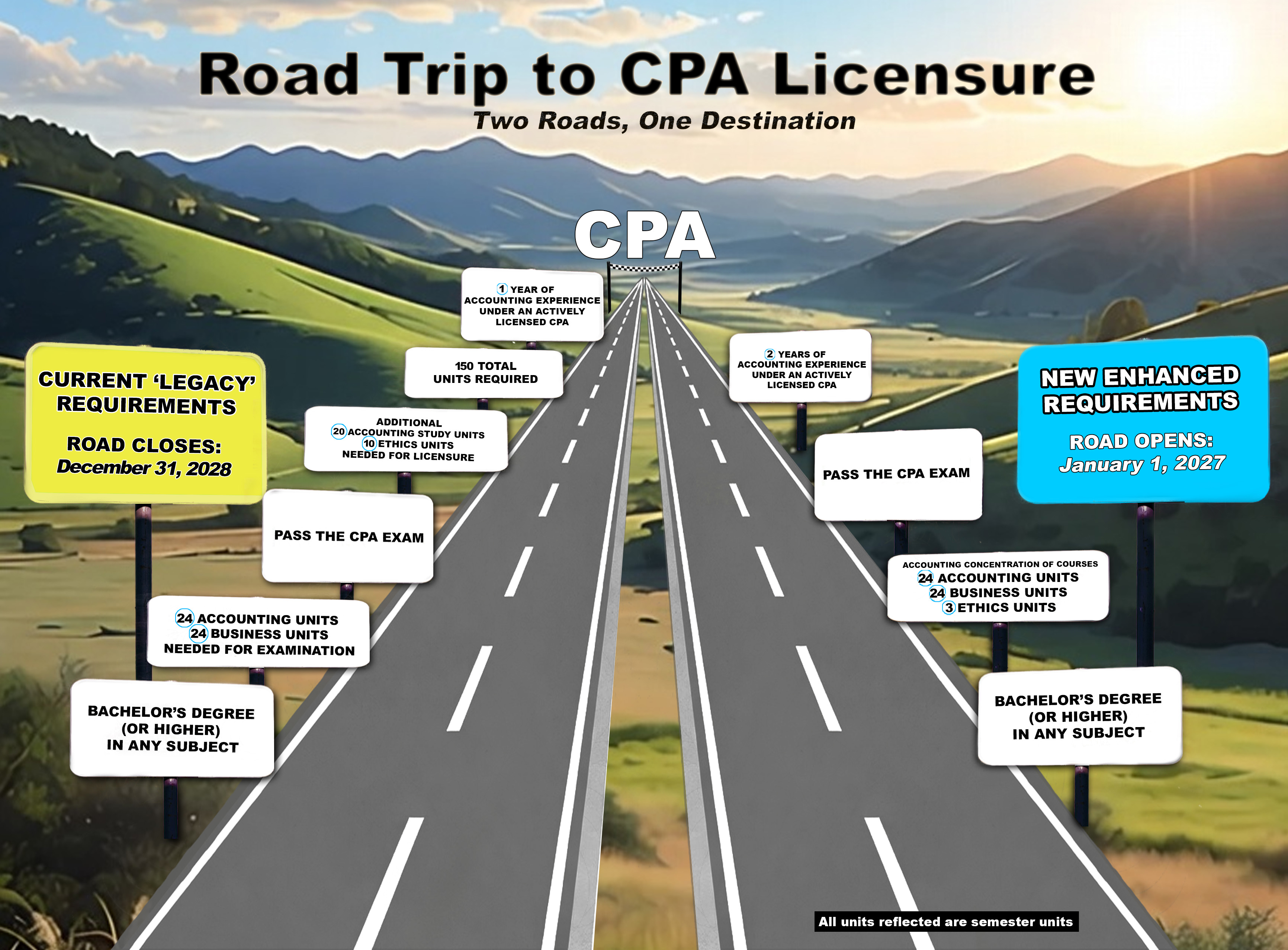
CBA versions of this graphic: full-size image · Road Trip to Licensure — Your CPA Roadmap (PDF)
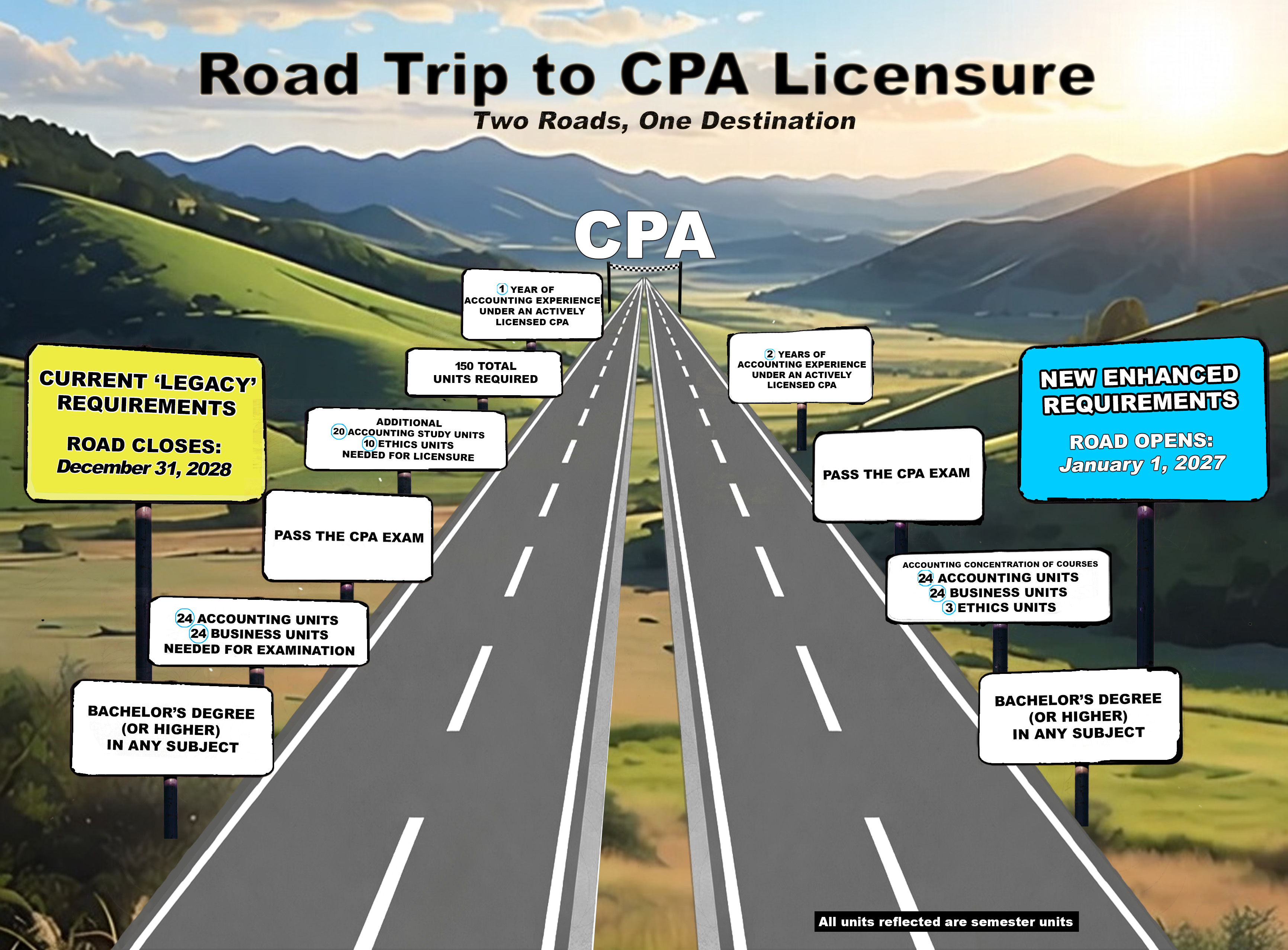
What each road requires
| Legacy road (closes Dec 31, 2028) |
New road (opens Jan 1, 2027; required from Jan 1, 2029) |
|
|---|---|---|
| Degree | Bachelor’s (or higher) in any subject | Bachelor’s (or higher) in any subject |
| Units to sit for the exam | 24 accounting + 24 business | 24 accounting + 24 business + 3 ethics, as an accounting concentration of courses |
| Exam | Pass the CPA Exam | Pass the CPA Exam |
| Extra education after the exam | 20 accounting study units + 10 ethics units, to 150 total semester units | None — education for exam and licensure is the same |
| Experience | 1 year general accounting experience | 2 years general accounting experience |
| When you can use it | If you apply by Dec 31, 2028 | Jan 1, 2027 onward |
The headline change is that on the new road there are no additional educational requirements beyond what is required for the CPA Exam. The 150-unit total is eliminated and the extra post-exam units disappear, in exchange for a second year of experience. Both roads lead to the same license.
Source: CBA, Your Guide to the New CPA Licensure Requirements and the Road Trip PDF above; AB 1175.
Substitutions on the new road
Two options can shorten the two-year experience requirement. They are either/or — you get credit for one, not both.
| Option | What it does |
|---|---|
| Advanced degree in accounting or a related subject | Substitutes for 12 months of experience |
| CBA-recognized certificate (e.g., a community college or extended-studies certificate) | Satisfies the accounting concentration of courses and substitutes for 6 months of experience |
Separately, a CBA-recognized bachelor’s or advanced degree fully meets all educational requirements on its own.
The specific recognized degrees, certificates, and the contents of the accounting concentration are being defined by CBA regulation during 2026, so treat the details as provisional.
Source: CBA Road Trip PDF; CBA, California Legislation; AB 1175.
Key dates
| Date | What happens |
|---|---|
| Jan 1, 2026 | AB 1175 takes effect. 2026 is an implementation window while the CBA finalizes regulations. |
| Jan 1, 2027 | New pathway becomes operative — the new road opens. |
| Jan 1, 2027 – Dec 31, 2028 | Both roads are open. You may license under either one, whichever fits your units and experience better. |
| Dec 31, 2028 | Last day to submit a California licensure application under the legacy requirements. |
| Jan 1, 2029 onward | New requirements only; the legacy pathway is repealed. |
The decision rule: if you will submit your California licensure application by Dec 31, 2028, you may choose either road. If you will apply on or after Jan 1, 2029, you must use the new one.
Source: CBA, Your Guide to the New CPA Licensure Requirements; AB 1175.
An advising note on master’s programs
A master’s degree (MAcc/MSA/MS Tax) deepens technical competence, and under AB 1175 a qualifying advanced degree can substitute for 12 months of experience. We are aligning curricula with the CBA’s forthcoming recognition program so that transcripts and substitutions are straightforward once the regulations are final.
The experience requirement in detail
The rules below govern the experience requirement as it stands today (one year). The substitutions and the move to two years described above are what change on the new road; the definitions, supervision rules, and forms carry over.
How much experience, and what kind?
- General accounting experience: currently a minimum of one year (becoming two years on the new road). It may include any type of service or advice involving accounting, attest, compilation, management advisory, financial advisory, tax, or consulting skills.
- Attest authority (optional): to be licensed with the authority to sign reports on attest engagements, you need the general experience plus a minimum of 500 hours of attest experience. The CBA defines attest engagements as an audit, a review of financial statements, or an examination of prospective financial information — not the issuance of compiled financial statements.
- Without attest authority you can still perform a wide range of accounting services; you simply cannot sign attest reports until the 500 hours are completed and the CBA grants authorization. You can be licensed first and add the authority later.
Where the experience can come from
- Public or non-public accounting — private industry and government both count.
- Internships, contract work, and volunteer work may be accepted.
- Experience may be completed through more than one firm.
- Part-time counts: 170 part-time hours = one month.
- There is no expiration date on work experience, and it may be completed before you sit for the Uniform CPA Exam.
- Teaching: accounting-subject courses at an accredited college or university count; 48 semester units of instruction = one year of general accounting experience.
Supervision rules
- Experience must be obtained under the supervision or in the employ of an individual holding a current, active, and unrestricted license to practice public accountancy. Verify status with the CBA’s License Lookup.
- For non-public accounting experience, the supervisor must be a CPA licensed in the United States.
- “Supervised” means the supervisor reviewed and evaluated your qualifying work on a routine and recurring basis and had authority and oversight over you. They do not have to be your direct supervisor.
- If you perform attest services as part of your general experience, your supervisor must themselves have satisfied the attest experience requirement.
- A licensee hired to provide public accounting services to your firm may not also supervise your work experience.
- Work must be performed in accordance with applicable professional standards.
- The CBA may require you, your supervisor, or both to appear before its Qualifications Committee to substantiate the experience.
The forms
| Form | Use |
|---|---|
| Certificate of General Experience (PDF) | Documents general accounting experience |
| Certificate of Attest Experience (PDF) | Documents the 500 hours of attest experience |
How the Certificate of General Experience works:
- Who completes it: the licensed CPA who supervised your services — not you. They certify under penalty of perjury that you were supervised or employed by them or their firm for the period listed and that you completed the general accounting experience.
- When: upon your request. The CBA views failure to submit the certificate as an attempt to impede the applicant’s certification, and it may result in disciplinary action against the supervisor.
- What it asks for: your full legal name (no initials), SSN, the supervisor’s business name, address, phone, and license information, and the period of employment — full-time from/to dates, part-time from/to dates, and total part-time hours.
- Who it applies to: licensure applicant Types A, B, C, and E (Type A = passed the Uniform CPA Exam in California, never licensed in any state, applying in California for the first time).
- Submitting it: it may be digitally signed and submitted when you apply for a CPA license online, emailed by the supervisor or the applicant to licensinginfo@cba.ca.gov, or mailed to the CBA. Passing the Uniform CPA Exam is not required before submitting it.
Governing rules: California Code of Regulations, title 16, sections 12, 12.1, 12.5, and 69.
Source: CBA, CPA Licensure Experience Requirements and the Certificate of General Experience form itself.
FAQs
Which road should I take?
If you are on track for 150 units and a year of experience before the end of 2028, the legacy road may still be the shortest. If you are short of 150 units, the new road trades those units for a second year of experience. Compare your own unit count and experience against the table above and talk to an advisor.
What counts as an “advanced degree” or a “recognized certificate”?
AB 1175 authorizes the substitutions; the CBA will specify the eligible subjects, degrees, and certificate programs by regulation during 2026. Until those are published, no definitive list exists.
Can I apply to take the CPA Exam before I finish my degree?
Possibly — the CBA’s Option C lets you apply while still enrolled if you are within 180 days of completing all exam education requirements. The SSU process and the CBA instructions, including the Certificate of Enrollment (COE-1) and who signs it, are in Applying to Take the CPA Exam Early (California Option C).
What if I plan to license in another state?
AB 1175 is a California law. If you might pursue licensure elsewhere, check that state’s board for its own rules.
Where do I check my own education against the requirements?
Use the CBA’s Self-Assessment Worksheet for the CPA Licensure Educational Requirements.
What to do now
- Map your timeline: will you submit your California licensure application in 2027–2028, or 2029 and later?
- Choose a road using the comparison table and the decision rule above.
- Plan courses: aim at the accounting concentration as the CBA defines it once regulations are final.
- Plan experience: line up supervised roles that meet the supervision rules — and remember internships and part-time hours count.
- Watch for the 2026 regulations, which will settle the recognized degrees and certificates.
Sources
California Board of Accountancy — AB 1175 and the new requirements
- Your Guide to the New CPA Licensure Requirements
- Road Trip to Licensure — Your CPA Roadmap (PDF) · roadmap graphic (JPG)
- California Legislation
- Chaptered bill text — AB 1175 (Chapter 293, Statutes of 2025)
California Board of Accountancy — experience and application
- CPA Licensure Experience Requirements
- Certificate of General Experience (PDF) · Certificate of Attest Experience (PDF)
- I Am a CPA Licensure Applicant — where the experience forms live
- License Lookup — verify a supervisor’s license is current, active, and unrestricted
- Applicants home — information for both Exam and Licensing applicants · FAQs about becoming licensed · Self-Assessment Worksheet
Exam content and career resources
- CPA Exam toolkit (AICPA & CIMA)
- Uniform CPA Examination Blueprints — the current Blueprints took effect January 1, 2026; the AICPA replaces the PDFs as they are revised, so use this hub rather than a saved file
- CPA Evolution — the Core-plus-Discipline exam model, launched January 2024
- Why CPA?
At Sonoma State
- Applying to Take the CPA Exam Early (California Option C) — the SSU department process and CBA instructions for the Certificate of Enrollment (COE-1)
- Accounting Forum, the SSU student club — to join, email Joe Standridge, the club’s faculty advisor.
Disclaimer: This summary is for advising only. Final requirements are set by the California Board of Accountancy and the chaptered bill, and the 2026 regulations are not yet complete.